Robotic pizza restaurant opens in California A pizza place in California is getting automated, with robots doing a good part of the pizza making. Carter Evans has more.
But before you write a resignation letter to your boss in anticipation of never needing to work again, be warned: there are multiple questions, including how to finance such schemes. Here is a look at the issues.
Why the mounting interest?
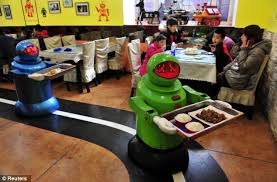
In a word, robots. With automated systems and machines increasingly replacing human workers, France could lose 3 million jobs by 2025, says Benoit Hamon, a former education minister campaigning for the French presidency on a promise of gradually introducing no-strings-attached payments for all. As work becomes scarcer, a modest but regular guaranteed income would stop people from fearing the future and free up their time for family, the needy and themselves, he argues.
It could also encourage people to take risks, start businesses and try new activities without the risk of losing welfare benefits.
The other pro-basic income candidate for the Socialist Party presidential ticket is outsider Jean-Luc Bennahmias. Like Hamon, the former European Parliament lawmaker argues that it is pointless to expect the return of economic boom times, with jobs for all.
“Growth at two, three, four or five percent in western countries: it’s finished,” he said in a televised debate last week.
Outside research backs up their arguments. An Oxford University study in 2013 estimated nearly half of the American workforce is at risk of automation.
The topic was the subject of passionate discussion in Davos, Switzerland, ahead of the World Economic Forum’s annual meeting of global leaders. CEOs considered the role of education in coping with artificial intelligence and the possibility that new technology would create new, as-yet-unknown jobs.
The test vehicle Acura is using to test its autonomous Automated Drive shown at the 2016 Los Angeles Auto Show. A number of technology companies and automakers are racing to create self-driving technology that promises to make traditional taxi jobs obsolete.
REUTERS
 Put to the test
Finland’s small-scale, two-year trial that started Jan. 1 aims to answer a frequent question from basic income opponents: With a guaranteed 560 euros ($600) a month, will the 2,000 human guinea pigs — drawn randomly from Finland’s unemployed — just laze around?
Budget constraints and opposition from multiple quarters stymied ambitions for a broader test, says Olli Kangas from the Finnish government agency KELA, which is responsible for the country’s social benefits.
“It’s a pretty watered-down version,” he said in a telephone interview. “We had to make a huge number of compromises.”
Still, he argues that such studies are essential in helping societies prepare for changed labor markets of the future.
“I’m not saying that basic income is the solution,” he said. “I’m just saying that it’s a solution that we have to think about.”
In the Netherlands, the city of Utrecht this year plans to try no-strings welfare payments that will also allow test groups to work on the side if they choose — again, in part, to study the effect on their motivation to find work.
To prepare for “a world where technology replaces existing jobs and basic income becomes necessary,” Silicon Valley startup financier Y Combinator says it plans a pilot study in Oakland, California, paying recipients an unconditional income because “we want to see how people experience that freedom.”

CBS This Morning
 Privacy concerns for smart dolls and home devices?
Some of the hottest buys these days are internet-connected devices, like the Amazon Echo and Google Home. They use voice recognition technology t…
The cost
Obviously, expensive. Hamon proposes the gradual introduction of basic income schemes in France, starting with 600 euros ($640) per month for the nation’s poor and 18-to-25-year-olds before scaling up payments to 750 euros ($800) for all adults — for a total estimated annual cost of 400 billion euros ($425 billion).
Part of the cost could be financed by taxing goods and services produced by automated systems and machines, he says. Opponents argue that doing so would simply prompt companies to move robots elsewhere, out of reach of French tax collectors.
Doing away with housing, family, poverty and unemployment benefits could free up more than 100 billion euros ($106 billion) to fold into a replacement basic income scheme.
There’d also be less red tape, saving money that way, too, but switching to basic income would still require new taxes, a 2016 Senate report said.
It estimated that paying everyone 500 to 1,000 euros ($530-$1,100) per month would cost 300 billion to 700 billion euros ($745 billion-$320 billion) annually. It recommended starting with three-year pilot schemes with trials involving 20,000-30,000 people.
The cons
Costs aside, opponents argue that guaranteed incomes would promote laziness and devalue the concept of work. Hamon’s opponents for the Socialist presidential ticket disagree with his assessment that jobs for humans are growing scarcer.
Ultimately, to see the light of day, basic income schemes will need political champions, said Van Parijs.
“We need radical ideas as targets and then we need clever tinkering to move in that direction,” he said.
Contributing for CBS News from Davos: Lulu Chiang, Lauren Hoenemeyer and Gilad Thaler.

No comments:
Post a Comment